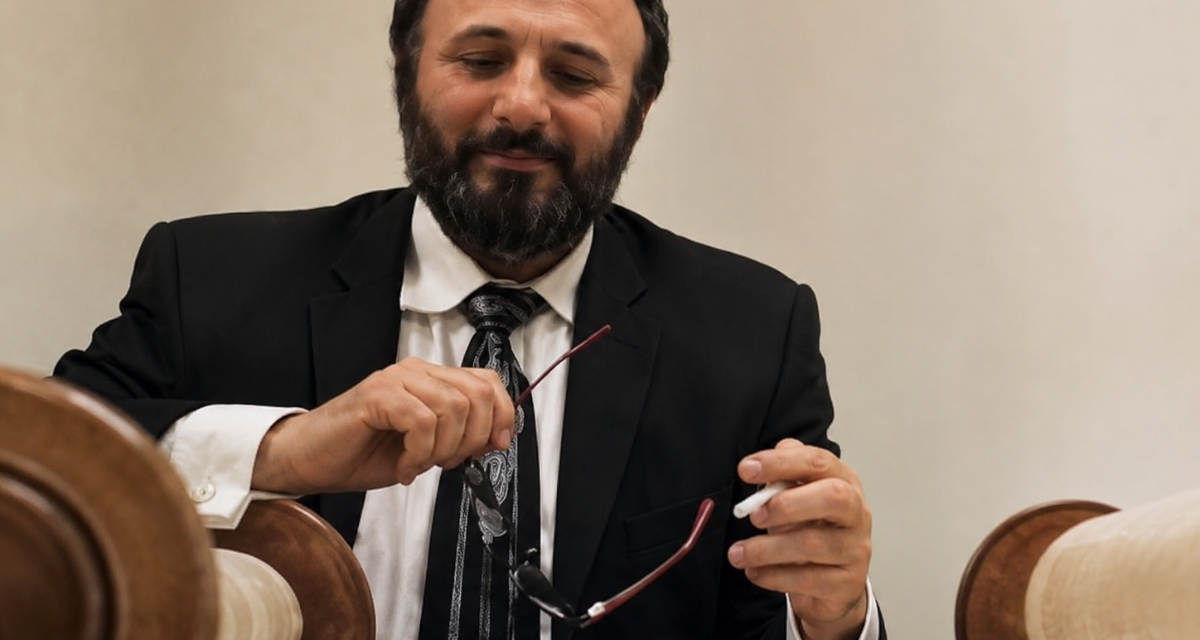
Rabbi Steve Karro is a scribe and Judaica artist based in Miami Beach, Florida. He works on Torah scrolls, mezuzahs, and tefillin, and he also paints on canvas and parchment. This Q&A asks him a simple question that turns out to have a complicated answer: how does he know when a piece of work is actually done?
When do you know a Torah scroll or a piece of art is finished?
“It is not a feeling, it is a checklist in my head. Every letter has a shape it has to have, and every line has a place it has to sit. When those two things line up, the work is finished. I do not go by whether I like it that day, because some days I like everything and some days I like nothing. I go by whether it meets the standard, and the standard does not move with my mood.”
Is that different from how you judge a painting?
“A little. With a painting there is more room for me, because it is my interpretation and nobody is checking it against a fixed text. But even there, I ask myself if it says what I meant it to say. If I look at it and it says something else, it is not finished, even if it looks pretty. I would rather it look a little rough and say the right thing.”
Do you ever finish something and then go back and redo it?
“Yes, and I do not think that is a failure. I think it means I was honest with myself the second time. Early in my work I would have been embarrassed to admit that. Now I see it as part of the process. If I never went back to fix anything, it would mean I was not looking closely enough the first time.”
What is the hardest part of judging your own work, as opposed to someone else’s?
“With someone else’s work, I have distance. I can look at a scroll a colleague wrote and see right away if a letter is off. With my own hand, I have to fight the instinct to see what I meant to write instead of what is actually on the parchment. That takes discipline. I have trained myself to slow down and look at the page like it is not mine.”
How do you measure whether the day went well?
“Not by how many pages I finished. Some days I finish very little because I am being careful, and that is still a good day. I measure it by whether I did the work the way it is supposed to be done. If I rushed something to get more done, that is a bad day even if the number looks good.”
Has your sense of a job well done changed over the years?
“When I was younger, I think I measured it by whether people were impressed. Now I measure it by whether the work holds up when nobody is looking at it, including me. A scroll gets read for generations. It has to be right whether or not anyone ever compliments it.”
Do you apply the same standard to teaching as you do to the scribal work?
“I try to. With teaching, the sign that it went well is not whether the student thanks me at the end of the lesson. It is whether they can go do the thing correctly on their own, later, when I am not there. That is a harder thing to measure, because I do not always get to see it. But it is the real test.”
What tells you something is wrong before you can even explain why?
“Sometimes I look at a line of text and something feels off before I can name it. That comes from doing this for a long time. I have learned to trust that feeling enough to stop and look closer, even if I cannot immediately say what is wrong. Usually, when I look closer, I find it. A letter is slightly too wide, or the spacing before it is slightly too narrow.”
Is there a version of “good enough” in this work, or does everything have to be perfect?
“There is a real standard for kosher, and it is exact. Below that standard, the work does not count, no matter how close it looks. Above that standard, there is still room to write more beautifully, and I keep trying to do that. So the honest answer is that there is a hard floor, and above the floor, I am never fully satisfied. I do not think I am supposed to be.”
What would you tell someone just starting out about judging their own work?
“Do not wait until you feel proud of it. Feeling proud comes and goes, and it is not reliable. Learn the actual standard, the real rules for the letters and the lines, and check your work against that instead of against your mood. If you do that consistently, the pride follows on its own, later, when you look back at what you made.”
Does that same approach carry over into how you judge your day, outside the work itself?
“I ask myself if I did something that made a real difference for someone, even something small. Not whether I felt good about myself, because that can be its own trap. I ask whether someone else is better off because of something I did that day. If the answer is yes, I consider it a good day, even if nothing about the scroll or the painting went the way I planned.”
About The Author