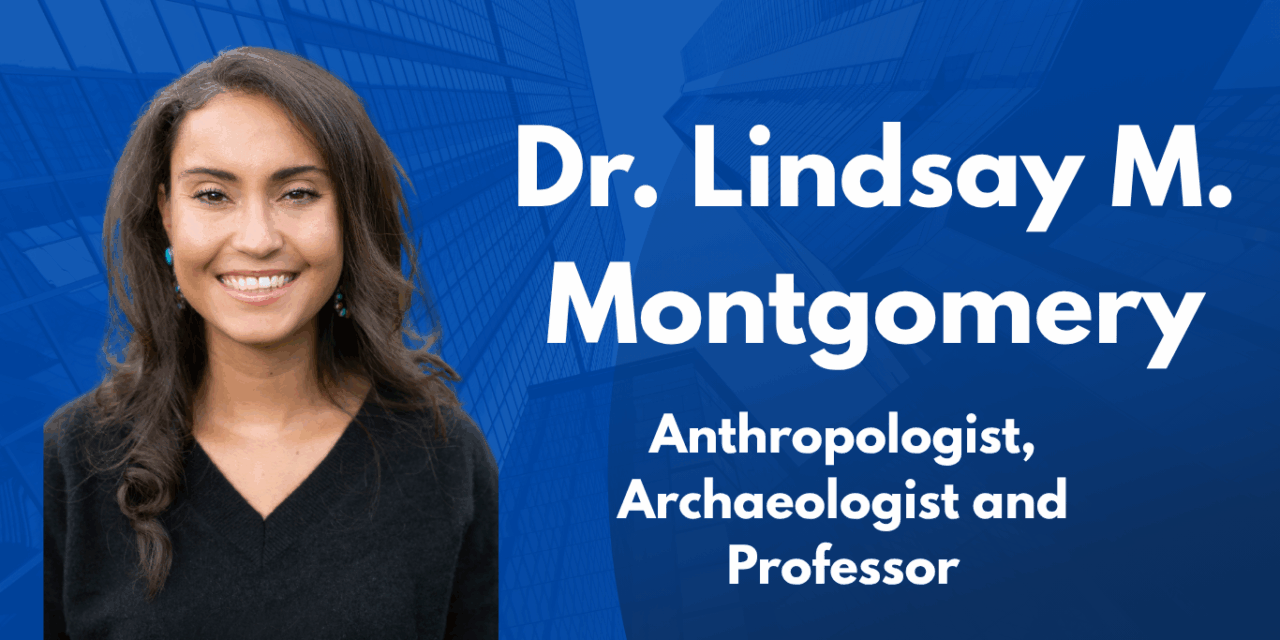
Dr. Lindsay M. Montgomery is a leading anthropologist, archaeologist, and thought leader specializing in Indigenous heritage research and community-driven scholarship. As an Associate Professor at the University of Toronto, Dr. Montgomery bridges the gap between academic research and real-world application, offering innovative solutions for organizations, institutions, and Indigenous communities seeking to engage meaningfully with cultural heritage issues.
With a Ph.D. from Stanford University and extensive field experience across North America, Dr. Montgomery’s work centers on collaborative research that integrates archaeology, oral traditions, and Indigenous knowledge systems. Her expertise supports institutions in developing ethical research frameworks, strengthening community partnerships, and advancing decolonial practices in cultural resource management and heritage preservation.
Recognized nationally and internationally, Dr. Montgomery’s research has been supported by prestigious organizations, including the Wenner-Gren Foundation and the Social Sciences and Humanities Research Council of Canada (SSHRC). She is committed to creating sustainable, culturally sensitive heritage projects that prioritize Indigenous voices and leadership at every stage.
In addition to her academic achievements, Dr. Montgomery actively consults with nonprofits, museums, universities, and governmental agencies to help shape policies and programs that reflect a deep respect for Indigenous histories and contemporary realities. Her dynamic speaking engagements, advisory services, and public scholarship initiatives have positioned her as a trusted voice in the field of Indigenous heritage research and ethical archaeology.
Dr. Montgomery’s perspectives on leadership, innovation, and community engagement have been featured in interviews such as “Getting to Know Professor Lindsay M. Montgomery” and on platforms like IdeaMensch.
What inspired you to pursue archaeology, and how has that inspiration changed over time?
I came into archaeology with a deep curiosity about history and the material traces people leave behind. As a student, I was captivated by excavation, by the idea of revealing stories long buried. But it wasn’t long before I started to see the power dynamics embedded in the discipline—the way certain narratives were privileged, while others were erased or misrepresented. Over time, especially through relationships with Indigenous colleagues and communities, my perspective shifted. What began as a fascination with the past became a responsibility to the present. Now, my work is guided by questions of justice, care, and accountability. It’s not just about what we study—it’s about who we’re doing the work for, and with.
You’re a co-author on a forthcoming article in American Antiquity about archaeological reclamation. What does reclamation mean in your work?
Reclamation is both a framework and a practice. It’s about returning control—over knowledge, narratives, and research processes—to communities who have historically been excluded from or harmed by archaeological work. It moves beyond restitution or reconciliation, because it’s not just about addressing harm after the fact—it’s about restructuring how we do the work from the beginning. For me, reclamation is about shifting power. That means co-developing research questions with communities, respecting Indigenous data sovereignty, and challenging institutional systems that have privileged Western knowledge above all else. It’s about making space for survival, for story, and for self-determination.
What was the collaborative process like for “Questions Worth Asking”?
It was incredibly rewarding—and honestly, a bit transformative. The group that came together to write the article came from diverse backgrounds, institutions, and lived experiences. What united us was a shared desire to do better in our field. The process wasn’t always easy. We had to work through tensions, disagreements, and moments of discomfort. But we also created space for care, honesty, and mutual respect. That’s what made the writing so powerful. We weren’t just writing about reclamation—we were practicing it, together. That spirit of collaboration shaped every word. I think that comes through in the article. It’s not just a critique; it’s a collective vision for change.
Why is centering Indigenous voices in archaeology so urgent right now?
Because for too long, archaeology has been a tool of erasure. Indigenous peoples have always known their histories, their lands, their ancestors—but archaeology often ignored or dismissed that knowledge. Centering Indigenous voices isn’t about inclusion for the sake of optics. It’s about correcting a profound imbalance. It’s about restoring authority over heritage, over stories, and over how the past is understood. And it’s about ensuring that archaeological practice doesn’t reproduce colonial violence. In the face of rising right-wing populism and attacks on equity, this work is more urgent than ever. We need to protect and amplify Indigenous-led research, not just include it when convenient.
Your work often highlights Indigenous data sovereignty. Can you explain what that looks like in your projects?
Data sovereignty is the right of Indigenous communities to control their own information—whether that’s oral histories, field data, digital records, or physical artifacts. In my work, it means designing research in ways that prioritize community governance at every stage. For example, with the Picuris Pueblo Archaeological Research Project, data management plans are developed with the tribal council. Nothing is published or archived without their consent. Findings are stored in community-controlled repositories, and we work to ensure access remains with the people whose histories we’re working with. It’s a shift away from extractive models and toward true reciprocity and responsibility.
You’ve used the term “undisciplining archaeology.” What does that mean, and how does it guide your practice?
To “undiscipline” archaeology is to question its assumptions—about objectivity, about authority, about who gets to speak and who gets studied. It means looking at how the discipline has been shaped by colonialism, capitalism, and racism—and then actively working to unmake those influences. In practice, undisciplining means valuing relational knowledge. It means welcoming oral traditions, ceremony, and community memory as legitimate forms of evidence. It means stepping back from academic ego and creating space for others to lead. Undisciplining doesn’t mean abandoning rigor—it means broadening our definitions of rigor to include respect, responsibility, and relevance to real communities.
How do you navigate the balance between academic publishing and public-facing work?
It’s something I’m constantly reflecting on. Academic publishing matters—especially when it helps shift disciplinary norms or influence policy. But if we’re only speaking to other scholars, we’re missing the point. That’s why I’ve also prioritized writing for public outlets like SAPIENS. Public scholarship can make our work more accessible, more accountable, and more impactful. It’s also a way to return knowledge to communities who’ve contributed to the research. I try to make space for both—articles that push at disciplinary boundaries, and pieces that speak to a broader audience. Both forms matter. Both have the potential to make change.
The article also speaks to white supremacy in the field. How do you approach that conversation in your teaching and mentorship?
Honestly and directly. We can’t train a new generation of archaeologists without confronting how the field has historically upheld white supremacist logics—through its methods, its archives, and its institutional structures. In my courses, we look at the history of anthropology and archaeology critically. We examine how knowledge production has been shaped by exclusion. And we talk about what it means to resist that in our work. I also mentor students—especially BIPOC students—who are navigating these systems and trying to find space for their own scholarship. That means offering support, being transparent about my own mistakes, and helping them build networks of care and solidarity.
In your work, you emphasize relationship-building and long-term trust with communities. How do you navigate moments when that trust is tested or challenged?
Trust is something you earn over time, and it’s something you continually work to maintain—it’s not guaranteed by intention alone. In this kind of work, especially when it involves histories of harm and power imbalances, there will be moments of tension, misunderstanding, or misalignment. I’ve learned that how you respond in those moments matters more than anything else. For me, that means listening without defensiveness, being transparent about mistakes, and taking meaningful steps to address concerns. It also means being in conversation, not isolation—staying present, even when it’s uncomfortable. I’ve come to understand accountability as an ongoing process, not a single moment. It’s about showing up consistently, honoring the relationships you’ve built, and committing to do better—not just in your words, but in your actions.
What gives you hope in this work, despite the barriers?
The people. The communities I collaborate with. The students I teach. The colleagues who are asking hard questions and choosing to do things differently. There’s a growing movement within archaeology—especially among younger scholars—that refuses to accept the status quo. They’re not interested in gatekeeping. They’re committed to justice, to relational ethics, and to community-led research. That gives me hope. So does the resilience of Indigenous knowledge, which continues to thrive despite centuries of erasure. At the end of the day, this work is about building something better. And that’s worth the effort, every time.
About The Author