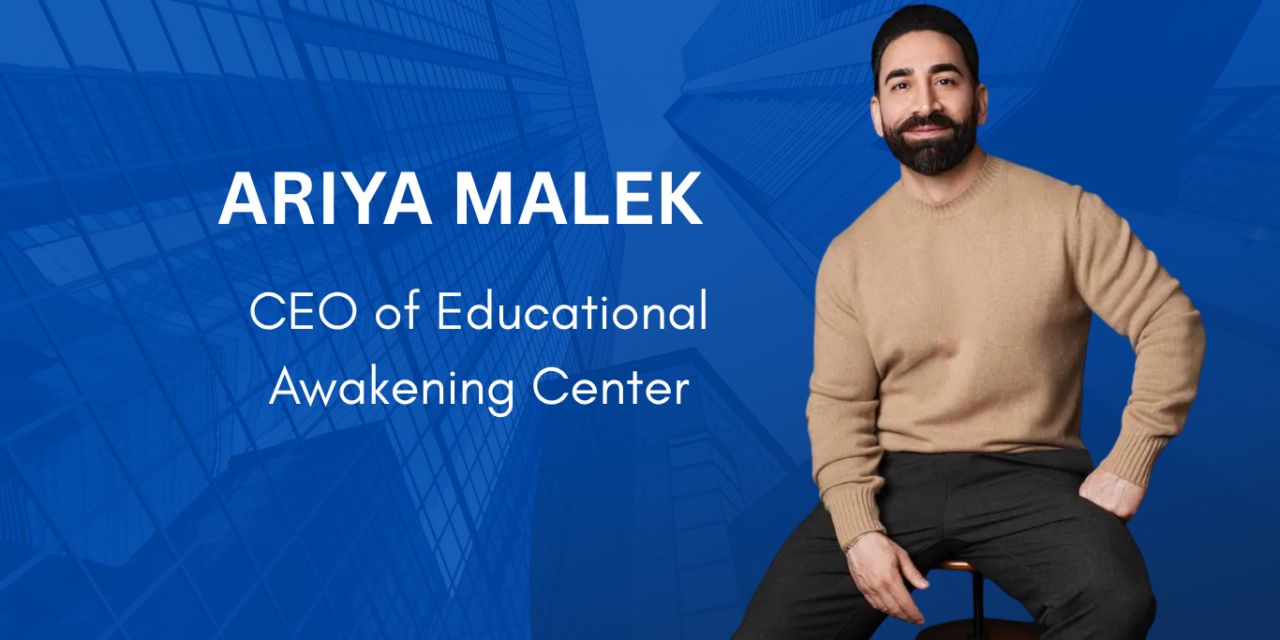
Ariya Malek is the CEO of Educational Awakening Center (EAC Seminars), where he leads the development of structured educational programs focused on self-awareness, mindset, and personal transformation. His work centers on helping individuals and professionals understand the deeper behavioral and cognitive patterns that influence decision-making, communication, and long-term personal development. Through EAC Seminars, Malek has built a platform that goes beyond surface-level motivation by emphasizing practical frameworks and applied learning. His programs are designed to help participants identify the root causes behind recurring challenges rather than focusing only on external symptoms. This approach allows individuals to develop clearer insight into their thought processes, emotional responses, and behavioral habits, enabling more intentional and effective decision-making.
In addition to leading EAC Seminars, Malek is a contributor to the Forbes Councils, where he publishes thought leadership articles on self-awareness, human behavior, and intentional growth. His writing reflects a commitment to clarity and depth, translating complex psychological and behavioral concepts into accessible insights for a broader professional audience. EAC Seminars continues to expand its reach through seminars, digital learning platforms, and educational content distributed via Substack and social media. Across all channels, Malek’s focus remains consistent: helping individuals develop a deeper understanding of themselves so they can make more informed choices and create meaningful, sustainable change in both their personal and professional lives.
What inspired you to move beyond traditional motivational content and focus instead on structured education around self-awareness and behavioral patterns?
What pushed me in that direction was noticing a gap between inspiration and real transformation. Motivation often creates short bursts of energy, but it rarely changes how people think or behave long term. I became more interested in why people repeatedly struggle with the same patterns despite knowing what they should do. That question led me toward structure, frameworks, and deeper behavioral understanding. At Educational Awakening Center, the goal became building learning experiences that help people see themselves more clearly. Once someone understands their internal patterns, decisions become more intentional, and change stops being temporary and becomes sustainable over time.
You often emphasize understanding “root causes” rather than symptoms. Can you explain what that looks like in practice within your seminars?
In practice, focusing on root causes means we don’t stop at surface-level behaviors like procrastination, poor communication, or lack of discipline. We explore what drives those behaviors underneath. That could be fear, identity conflicts, conditioning, or unresolved thinking patterns. In our seminars, participants are guided through reflection exercises that help them trace outcomes back to decision-making habits and emotional triggers. The goal is to slow down automatic responses and make them visible. Once people can see the origin of a behavior, they are no longer reacting blindly. They gain the ability to interrupt and reshape the pattern consciously.
What are some of the most common misconceptions people have about personal development today?
One major misconception is that personal development is mostly about positivity or constant motivation. In reality, real development is often uncomfortable because it requires confronting patterns that people have relied on for years. Another misconception is that external knowledge alone creates change. People consume content but do not integrate it. There is also a belief that transformation is linear, when in fact it is iterative and often messy. At EAC, we focus on helping people understand that progress comes from awareness plus consistent behavioral adjustment, not just inspiration or information. Without application, even the best ideas remain theoretical.
How does Educational Awakening Center differentiate itself from other leadership and mindset training platforms?
The key difference is depth and structure. Many platforms focus on surface-level motivation or generalized leadership advice. At Educational Awakening Center, we focus on how thinking patterns form and how they influence decisions over time. We build frameworks that help individuals identify internal drivers behind their behavior. Our programs are less about telling people what to do and more about helping them understand why they do what they do. This creates longer-lasting change. We also emphasize practical application, so participants are not just learning concepts but actively working through their own decision-making and behavioral responses.
In your experience, what role does self-awareness play in decision-making, especially for professionals and leaders?
Self-awareness is the foundation of effective decision-making. Without it, people often confuse emotional reactions with rational judgment. In leadership, especially, decisions affect not just the individual but entire teams and organizations. When someone lacks awareness of their triggers, biases, or internal narratives, they may act impulsively or inconsistently. Self-awareness creates a pause between stimulus and response. That pause is where better decisions are made. It allows leaders to assess situations objectively rather than emotionally. Over time, this leads to more stable leadership, better communication, and stronger trust within teams because behavior becomes more predictable and intentional.
Many of your programs focus on behavioral patterns. How do you help participants actually recognize and change those patterns in real time?
We focus on bringing unconscious behavior into conscious awareness first. People cannot change what they do not see. Through guided exercises, reflection tools, and real-world scenarios, participants begin to identify repetition in their reactions and decisions. Once a pattern is recognized, we work on interrupting it at the moment it appears. This involves slowing down responses, questioning assumptions, and introducing alternative ways of thinking. Over time, repetition creates new default behaviors. The key is not perfection but consistency. Small interruptions of old patterns gradually build new mental pathways that become more aligned with intentional outcomes.
What trends are you seeing in how individuals and organizations approach personal development and emotional intelligence right now?
There is a clear shift from motivational content toward practical emotional intelligence and applied behavioral training. Organizations are realizing that technical skills alone are not enough to sustain performance in modern environments. With hybrid work and increased pressure, communication breakdowns and emotional fatigue are becoming more visible. Individuals are also becoming more skeptical of surface-level advice and are looking for frameworks they can apply in real life. There is growing interest in structured learning experiences that combine psychology, communication, and self-awareness in a way that directly connects to workplace performance and personal effectiveness.
You contribute thought leadership through platforms like Forbes Councils. How does writing shape or refine your ideas as a leader?
Writing forces clarity. When you translate ideas into structured language, you quickly see where your thinking is vague or incomplete. For me, writing is not just communication; it is a refinement process. It helps me test whether an idea is actually useful or just interesting in theory. Through platforms like Forbes Councils, I am also exposed to a broader professional audience, which challenges me to ground concepts in real-world relevance. Over time, writing has helped sharpen both the frameworks we use at EAC and the way we communicate complex behavioral ideas in a more accessible form.
What challenges have you faced in translating complex psychological or behavioral concepts into practical learning experiences?
The biggest challenge is simplification without distortion. Behavioral concepts can be complex, and there is always a risk of oversimplifying them to the point where they lose meaning. At the same time, if something is too academic, people disengage. The balance is in translating depth into clarity. Another challenge is that people often expect immediate results, while behavioral change takes time and repetition. We address this by focusing on practical frameworks that can be applied immediately, while reinforcing that transformation is a process. The goal is to make complexity usable without stripping away its depth.
Looking ahead, how do you envision the future of education around mindset, behavior, and intentional growth evolving over the next decade?
Education will move further toward personalization and behavioral integration. Instead of broad lectures or generic advice, people will increasingly engage with learning systems that adapt to their specific patterns and challenges. There will also be a stronger connection between emotional intelligence and performance metrics in organizations. Mindset and behavior will no longer be seen as abstract topics but as core components of productivity and leadership effectiveness. We will also see more blending of digital learning with real-time application tools, allowing individuals to practice and refine behavior in their actual environments, not just in theory.
About The Author