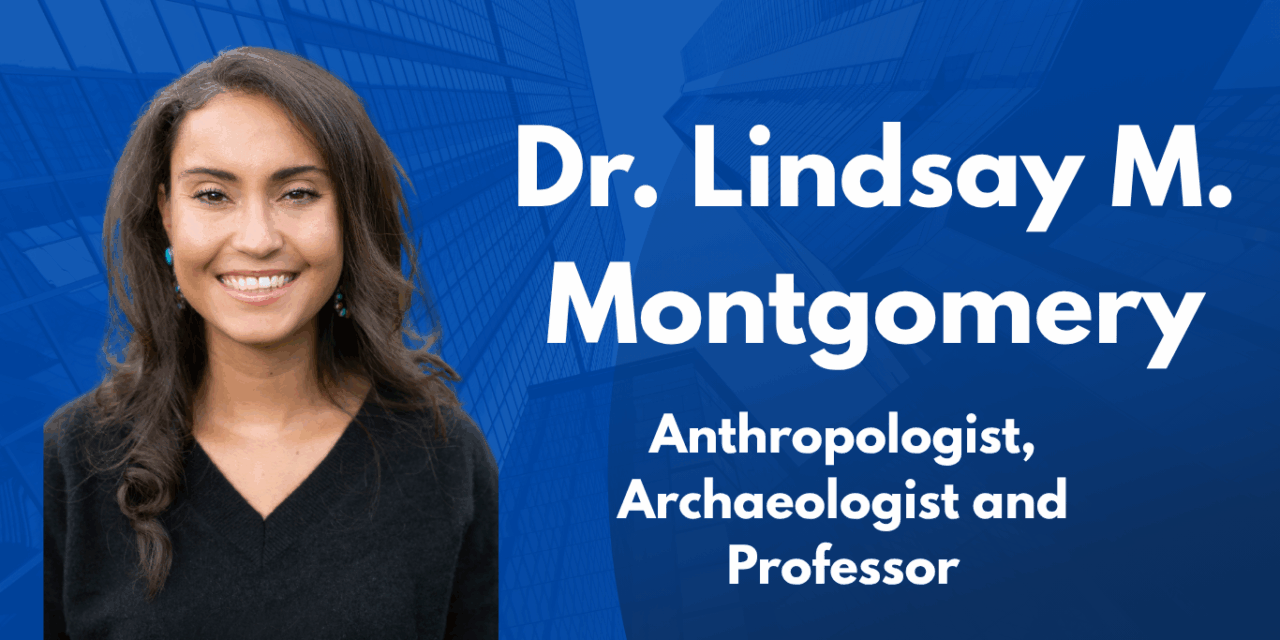
Dr. Lindsay M. Montgomery is an anthropologist, archaeologist, and consultant specializing in Indigenous heritage, collaborative research, and ethical cultural resource management. As an Associate Professor at the University of Toronto, Dr. Montgomery is at the forefront of developing community-driven models for research and heritage preservation that prioritize the voices and perspectives of descendant communities.
Earning her Ph.D. from Stanford University, Dr. Montgomery has built an influential career grounded in interdisciplinary methodologies and long-term partnerships with Tribal Nations across North America. Her expertise spans archaeological fieldwork, archival research, collections management, and public scholarship, helping organizations design programs and policies that respect and reflect Indigenous histories.
Dr. Montgomery has secured major grants from organizations such as the Wenner-Gren Foundation, National Science Foundation, and the Social Sciences and Humanities Research Council of Canada (SSHRC), underscoring the impact and innovation of her work. In addition to her academic role, she actively consults with museums, universities, nonprofit organizations, and governmental agencies, offering strategic support for projects that demand cultural sensitivity, ethical research standards, and inclusive community engagement.
A recognized leader in her field, Dr. Montgomery is committed to advancing decolonial practices within anthropology and archaeology. Her work encourages institutions to rethink traditional research frameworks and adopt approaches that are transparent, equitable, and sustainable.
Through public speaking, consulting, and advisory roles, Dr. Montgomery shares her expertise with a broader audience, contributing to vital conversations around Indigenous heritage, academic responsibility, and collaboration. She was recently featured in the University of Toronto’s “Getting to Know Professor Lindsay M. Montgomery” series and profiled on IdeaMensch for her innovative contributions to the field.
What does your typical day look like, and how do you make it productive?
My day begins early with a quiet moment—a brisk walk with my dog, Ruby, where I get the blood flowing and go over what I want to accomplish that day. Coffee in hand, mornings are typically reserved for writing, research, or community consultation meetings. Afternoons focus on class-prep, mentoring students, and responding to correspondence. I try to stay focused and productive by planning in time blocks and clearly separating creative “brain” work from administrative tasks. I also keep a flexible to-do list, prioritizing what aligns with long-term projects while managing short-term tasks that arise throughout the week. Productivity for me isn’t just about getting more done—it’s about working towards and staying connected to the bigger purpose behind the work I do.
How do you bring ideas to life?
Every idea starts with empathetic listening. Whether it comes from a conversation with an Indigenous collaborator, a student, or a moment in the field, I try to focus on first understanding their perspective rather than immediately reacting or looking for solutions. I then map out a collaborative path—identifying potential approaches, funding opportunities, or other partners and knowledge holders who can help. Bringing ideas to life is not a solo effort. It involves co-creation, communication, and patience. Most importantly, it has to make sense and be relevant to the person or community I’m working with; if an idea doesn’t resonate with others, it’s not worth pursuing. Implementation happens in layers, always revisited through feedback and shared decision-making.
What’s one trend that excites you?
The rise of BIPOC-led research and land-based education are really exciting trends I’ve seen in academia and heritage work. These approaches center non-Western knowledge systems and position Indigenous communities and other historically marginalized groups as the rightful leaders in scholarship about their histories and important places. This is not just a set of academic buzzwords—it’s a long-overdue shift in how research gets done. Seeing more institutions recognize this and adapt accordingly gives me hope. The movement pushes us to rethink what counts as “evidence” and whose voices should guide inquiry. It’s changing how we train students, design fieldwork, and imagine the future of archaeology.
What is one habit that helps you be productive?
Daily reflection is a habit that grounds my productivity. At the end of each day, I lace up my sneakers again and do a walking meditation with my dog. While on the move I try to clear my head and review what went well, what didn’t, and what needs attention tomorrow. It helps me track not only my workload but also how I’m feeling about it. Another technique I use is on Sunday night to set two intentions for the week— there aren’t just tasks, but values or themes I want to embody. For example, this week I wanted to focus on proactively expressing gratitude and thanks to my colleagues, friends, and family. This habit creates a rhythm to my workflow and helps me stay connected to the purpose behind the projects.
What advice would you give your younger self?
I’d tell myself to trust the slow path. As the great actress Mae West once said, “anything worth doing, is worth doing slowly”. Early in my career, I felt pressure to publish fast, climb the academic ladder, and demonstrate my value through external achievements. I now realize that deep, impactful work takes time, especially when done collaboratively and ethically. I’d also remind myself that saying “I don’t know” is powerful. It invites learning and partnership. Finally, I’d tell myself not to compromise on values for short-term gain. The relationships and trust you build by standing firmly in your ethics will outlast any temporary recognition or institutional validation.
Tell us something you believe that almost nobody agrees with you on.
I believe that progress is not a linear or solo process. In academia, we’re often told to become “subject matter experts,” and institutions tend to elevate personal achievements and intellectual ownership. I push against that. Instead I think about success as a constantly evolving benchmark that will inevitably involve setbacks and is a collaborative endeavor. This is why I love Dr. Melanie Stefan’s idea of a “CV of Failures”. Instead of focusing on feelings of shame or disappointment around failure, she encourages an open approach to sharing rejections, challenges, and unsuccessful projects that promotes resiliency and a sense of community.
What is the one thing you repeatedly do and recommend everyone else do?
I truly believe in the saying “movement is medicine”! Whenever possible, I step outside—whether on a trail, in a field site, or even just a quiet street near home. Being in motion helps me reconnect with the world around me , especially when much of my work is digital or institutional, and to clear my head of all the demands of the day. Taking time to slow down, calm our minds, and listen to my body has really improved my mental health and sometimes even inspires new ideas!
When you feel overwhelmed or unfocused, what do you do?
When I feel overwhelmed, I pause—completely. I step away from the screen and do something active. Just taking 5 minutes to disconnect by watering my plants or playing with my pup can help clear these cobwebs of anxiety and restore clarity. I’ve learned not to push through mental fog, but instead to recalibrate. Rest isn’t a luxury—it’s part of the work.
What is one strategy that has helped you grow your career?
Learning how to say no has been transformative. Early in my career, I felt pressure to accept every opportunity—every panel, committee, or co-authorship. But over time, I realized that the most rewarding and impactful work comes not from doing more of it, but from doing projects that align with my personal values, deepen community partnerships, and offer long-term impact. I think this practice also models sustainability for my students. I now assess every new opportunity through a simple question: Does this project excite me and move me closer to the work I believe in? If the answer isn’t a “hell yes”, it’s a gracious pass.
What was one failure in your career, how did you overcome it, and what lessons did you take away from it?
Early in my career, I led a research project that was academically strong but not fully grounded in community collaboration. While I was inspired by a lot of anti-colonial and social justice oriented theoretical approaches, I just didn’t have the time or networks needed to really implement these values by co-developing projects with Indigenous partners or descendant communities. This felt like a failure at the time, but I eventually realized that this was all part of the growth process. Now that I have a platform, I try to co-design every project from the beginning, prioritize relationship-building as much as research design, and create opportunities for students to get involved in the collaborative process from the ground up.
What is one business idea you’re willing to give away to our readers?
I’d love to see a digital platform that helps institutions and researchers self-audit their work through an Accountability Framework. While mechanisms like the Institutional Review Board exist for monitoring research ethics, these bureaucratic structures are primarily oriented around protecting institutions and follow rigid guidelines and definitions which don’t always align with community priorities or values. Instead, this tool would be grounded in the principles of relational accountability, community consent, and data sovereignty and could include case studies, interactive checklists, and recommendations for repair if harm occurs . Think of it as a cultural humility coach meets project planner. It could fill a major gap in research training and help shift norms across disciplines.
What is the best $100 you recently spent? What and why?
I recently spent $100 on an AI transcription service called Alice. I used this service to transcribe 20 hours of oral history interviews with tribal members which I had never gotten the time to fully review. Usually this sort of task would take me about 4 hours just to transcribe 1 hour of audio content, but with the help of generative artificial intelligence, I was able to convert all these files into searchable text documents within 1 hour. Amazing! Importantly, this service doesn’t have any third-party trackers, meaning that all the content, including speaker identities, remains protected. . That investment is an incredible archival tool that will help me share data with community members more efficiently while maintaining the principles of data sovereignty.
What is one piece of software that helps you be productive? How do you use it?
Notion has become my productivity hub. I use it to organize everything from project outlines and grant timelines to student check-ins and field notes. What I love most is its flexibility—I can create a collaborative workspace for a research team, manage my personal writing schedule, and track upcoming events all in one place. It’s especially useful when balancing multiple roles across academia, consulting, and community partnerships. By keeping everything centralized, it reduces mental clutter and makes room for creativity.
Do you have a favorite book or podcast from which you’ve received much value?
Braiding Sweetgrass by Robin Wall Kimmerer continues to shape how I think, teach, and engage. The book bridges Indigenous knowledge systems with scientific ecology, offering a deeply poetic and intellectually rigorous invitation to rethink our relationship with the natural world. Kimmerer’s concept of reciprocity—of giving back to the land and the communities we learn from—has become central to my own methodology. It’s a book I return to often, especially when I feel disconnected or overwhelmed. It reminds me that knowledge is rooted in care, ceremony, and responsibility.
What’s a movie or series you recently enjoyed, and why?
Reservation Dogs truly resonated with me. It’s one of the few shows created by and for Indigenous people that captures the humor, complexity, and resilience of contemporary Indigenous life. The characters are relatable, flawed, and beautifully human. It’s a narrative that resists stereotypes and instead centers Indigenous agency. As someone committed to community storytelling and ethical representation, this series felt like a breath of fresh air—and a powerful teaching tool.
Key Learnings:
- Deep collaboration begins with empathetic listening and co-creation, not just consultation.
- Movement is medicine and daily reflection supports clarity, purpose, and resilience.
- Saying no can be a powerful tool for aligning your work with your values.
- Go slow;, sustainable research must prioritize relationships over results.
- Small acts, when rooted in care and intention, can have lasting impact.
About The Author