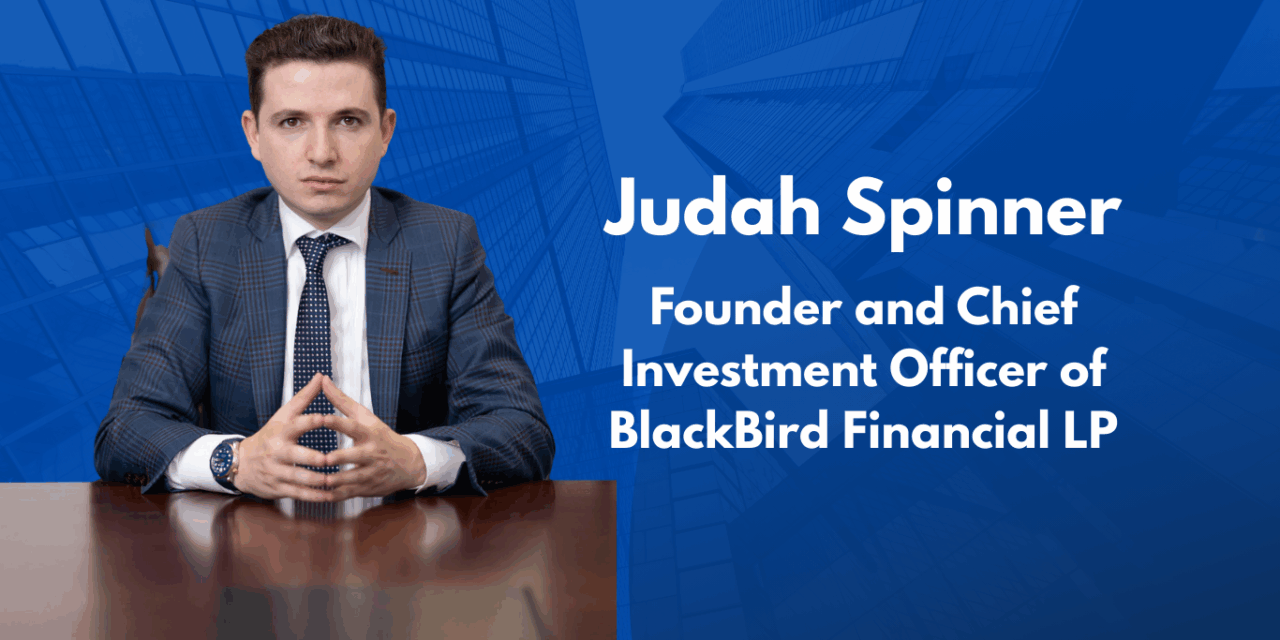
Judah Spinner is the Founder and Chief Investment Officer of BlackBird Financial LP, a New Jersey-based hedge fund known for its disciplined, value-oriented investment philosophy. Guided by the principles of Benjamin Graham and Warren Buffett, Spinner relies on rigorous fundamental analysis to make concentrated bets on high-conviction opportunities.
A financial prodigy, Spinner began reading The Wall Street Journal at 12 and was managing $100,000 by age 15 for New York real estate magnate Charles Dayan. At just 18, he launched what would become BlackBird, starting with over $1 million in assets under management. Under his leadership, the firm has substantially outperformed the broader market—most recently posting a 34.4% return in the first half of 2025.
Spinner holds the Chartered Financial Analyst (CFA) designation and has passed both the Series 7 and Series 66 FINRA exams. Beyond the world of investing, he is a licensed pilot, an adventurer who has completed the Mongol Rally, a classic car enthusiast, and a traveler who has visited all 50 U.S. states. He is also deeply committed to philanthropy, supporting educational and community-focused initiatives nationwide.
Through discipline, insight, and conviction, Spinner has built a reputation as an investor who plays the long game—and wins.
Your firm reported a 34.4% return in H1 2025, over 28 percentage points ahead of the S&P 500. What do you attribute this outperformance to?
We entered the year with Alibaba, Dollar General, and Avis as our top holdings, each of which saw a substantial increase in share price. However, as you know, we don’t place any weight on short-term performance. Luck plays an outsized role over shorter time periods, and we prefer to be judged on skill. Just as you wouldn’t judge a baseball player on a single swing, or even a single season, we believe investment performance should be
evaluated over a span of years. In the long run, our results reflect how well we’ve executed against our investment approach.
You’ve strictly adhered to bottom-up fundamental analysis, even during macroeconomic stress. How do you resist the pull of market sentiment or macro forecasts when making investment decisions?
At its core, successful investing means thinking with your head, not your heart. There’s no need to reinvent the wheel in this business. The investors with the strongest long-term track records overwhelmingly share one trait: they focus on businesses, not macro forecasts. I’ve long believed it’s nearly impossible to gain a sustainable edge by predicting the direction of the economy. And yet, Wall Street remains obsessed with macro commentary—not because it adds insight, but because it’s more exciting than studying the underlying economics of a single company.
At BlackBird, we ignore macro predictions—including my own. We focus on fundamentals we can actually analyze: pricing power, capital allocation, and management quality. Those are the levers that drive free cash flow, which is ultimately what matters. You don’t need to know whether nominal GDP will grow at 3.1% or 4.5% to feel confident owning a business trading at 60 cents on the dollar.
As Buffett said, “Forecasts may tell you a great deal about the forecaster; they tell you nothing about the future.
Your recent investment in Tidewater reflects a rare departure into an energy-adjacent space. What convinced you this was a fundamentally undervalued opportunity rather than a macro play?
To the contrary—Tidewater is right in our wheelhouse. We love finding businesses that were terrible for a long time but have quietly turned the corner. Usually, it takes years before the stock price catches up to the improved economics. That’s where the opportunity lies. Tidewater operates in an industry that went from being a capital sinkhole to one with decent economics. Supply is tight—there haven’t been many new offshore support
vessels built since the collapse in 2015—while demand is climbing. Day rates are rising, and the economics are improving with them. While it is true that Tidewater will earn more with crude at $100 than at $50, this is not a call on oil prices—we have no idea where oil is headed. What we do believe is that given the supply constraints and operating leverage, the company will earn strong returns—not every year, but on average over time.
In your letter, you expressed concern about the resurgence of tariffs under the current administration. How do rising trade barriers shape the kinds of companies you consider investable?
Yes, while the Trump administration has retreated from some of the most extreme tariff proposals, the average tariff rate remains at its highest level since the 1930s. Much of this added cost will ultimately be passed on to consumers, making it difficult to argue that it won’t exert upward pressure on inflation. All of this is fairly straightforward—yet there’s a striking sense of complacency on Wall Street. The disconnect is hard to ignore.
You’ve taken an activist approach with Natural Alternatives International, proposing operational and real estate changes. What inspired you to become more hands-on in this particular case?
With NAI, we saw a weak business with substantial tangible assets. They operate in the vitamin manufacturing space—a low quality, commodity-driven industry where a cost advantage is essential just to earn an adequate return on capital. Given NAI’s small scale, they have no realistic path to achieving lower costs than their much larger competitors. Layered on top of that are significant operational inefficiencies. The company owns valuable but underutilized real estate in Southern California and maintains an inflated headcount. Frankly, management has made a series of deeply damaging decisions.
We proposed reducing staff and monetizing portions of the real estate, as these steps could meaningfully enhance shareholder value. Our default approach is always to work constructively
with management in a non-confrontational way. But in NAI’s case, we see preventable value destruction at the hands of a management team steering shareholders toward the edge of a cliff. Shareholders deserve leadership that acts in their best interests. NAI has failed to meet that standard for many years— and we intend to do everything in our power to help set things right.
Many investors claim to follow Buffett-style investing. What differentiates BlackBird’s application of Grahamian principles from the broader crowd of so-called value investors?
Ben Graham wrote The Intelligent Investor, widely considered the bible of value investing. Millions of copies have been sold, and it’s been praised by nearly every legendary investor—but surprisingly few actually follow its principles. In my view, Graham is one of the most widely read yet least followed authors in finance.
It’s not because people don’t understand what he’s saying. It’s because following his advice—staying rational, focusing on intrinsic value, ignoring market noise—is simple in theory and incredibly difficult in practice.
I’ve seen this phenomenon play out in all kinds of ways. One of my clients is a marriage counselor who’d been helping couples for over two decades—brilliant communicator, nationally respected, has written a book on conflict resolution. But he is on his third divorce. He could spot a breakdown in communication a mile away… just not in his own living room. He gave incredible advice—he just can’t follow it himself.
There was a nutritionist that worked in my building who had a Ph.D., published research, ran workshops for Olympic athletes. She could explain the science of metabolism in her sleep. But every time I saw her, she was drinking Diet Coke and snacking on vending machine cookies. She told me once, “I know exactly what I should eat—I’m just not ready to give up the stuff I like.”
Investing is no different. The path to strong returns is simple in theory, but far from easy in practice. We all know that
spending 10 hours a day reading annual reports, Value Line, and other relevant publications will make you a better investor. Yet most managers spend the bulk of their time in meetings that have little bearing on actual investment outcomes.
We also know that the key to good investing is focusing on the underlying business and not letting market price swings cloud our thinking. And yet, when you listen to most investors explain a decision, they almost always start with recent price action. The first thing they look at is often a stock chart, not a balance sheet.
The truth is, in many areas of life, we know what it takes to succeed. But we fail to stick with it in the face of pressure, distraction, or social momentum. When every other CEO spends their day in meetings or at conferences, it’s difficult to spend yours alone reading 10-Ks. When prices flash across the screen all day long, it’s tempting to make them your focus.
In the final analysis, I believe we have outperformed most of our peers not because we know something our peers don’t, but simply because we’ve been done a better job at living by the principle preached by Graham and Buffett.
You’ve managed portfolios since you were a teenager and founded BlackBird at 18. What were the key lessons or early mistakes that shaped your current discipline?
When I was starting out, I tended to sell once a stock had gone up. In several cases, I had correctly identified a true 10- bagger opportunity but let most of the upside slip away by selling after the stock had merely doubled. What I’ve learned is that the only question worth asking when making a buy or sell decision is: What is it worth, and what price can I buy or sell it for? If intrinsic value remains well above the market price, we’ll hold the position—regardless of how far the stock has climbed since our initial investment. As Charlie Munger put it, “The big money is not in the buying and selling, but in the waiting.”
In a market increasingly driven by algorithmic and thematic trading, how does BlackBird maintain its edge through fundamental research?
There’s an interesting study from 1965 by Adriaan de Groot, titled Thought and Choice in Chess, which examined how chess masters think differently from computers when selecting moves. He found that while computers ran far more calculations— evaluating thousands of possibilities—the chess master was able to dismiss most options almost instantly, without conscious consideration. De Groot concluded that true mastery in chess relies not on brute-force computation, but on pattern recognition and intuition shaped by years of experience.
I believe the same holds true in investing. While certain black box quant funds—like Renaissance—have produced extraordinary results, the well-trained human mind still holds an edge in many areas. It will be fascinating to watch how AI evolves in investment decision-making over the next decade. If the day ever comes when we no longer have an edge, we’ll hang up our hats and move on to something else productive. That said, I don’t believe that day is coming anytime soon.
You’ve highlighted the importance of patience and valuation rigor. What’s your process for determining intrinsic value?
Every company we evaluate goes through a series of filters. The first is whether the business falls into the “knowable” category—and that has two components.
First, is the company operating in an industry where the fundamentals are unlikely to change dramatically over time? For example, the dynamics facing Tidewater today will likely look similar a decade from now. The industry is cyclical, with both fat and lean years, but the business itself doesn’t evolve much. In contrast, the leaders in fashion apparel in 2035 may bear little resemblance to those of today.
Second, is it something I can understand deeply? Take healthcare—while it may be knowable to others, it’s not within my circle of competence. So we exclude it. Any business I can’t
thoroughly understand is disqualified, no matter how appealing it may look on the surface.
Once we’ve established that a business is knowable, the next step is to determine what we’d be willing to pay to own the entire company. Because intrinsic value is ultimately the present value of all future cash flows, we focus on the company’s assets and earning power. This requires a lot of due diligence. Assets may be worth far more, or far less, than what’s recorded on the balance sheet. We need to do the work to estimate their true value. Likewise, a company’s earning power might differ significantly from its net income reported for the trailing twelve months. Our responsibility is to assess the long-term, sustainable earning power, not just read the headline numbers.
Put simply, buying a stock because it has a low P/E or P/B ratio isn’t value investing. It’s shallow, and it’s foolish.
There are many variables we consider in assessing earning power: Does the company have a durable competitive advantage? Is management capable and aligned? Are there opportunities to reinvest profits at high returns?
Once that analysis is complete, we ask one final question: is this idea more compelling than what we already own? If not, we’re better off adding to our existing positions.
That’s the framework we follow at BlackBird. It’s mentally demanding, often exhausting—and yet it’s always interesting and often very exciting.
Beyond finance, you’re a licensed pilot, a car enthusiast, and deeply involved in philanthropy. How do these pursuits align with your identity as an investor and leader?
Frankly, I don’t believe my recreational interests have any meaningful impact on my work. Flying planes does not make a great investor. Focus does. Warren Buffett’s lifestyle is a clear case in point. I spend less than 10% of my waking hours on
hobbies and roughly 65% on BlackBird, so these outside interests don’t hinder my concentration or effectiveness. What matters most is that I genuinely enjoy what I do—whether it’s work, hobbies, or other pursuits. I’m living the life I want to live.
About The Author