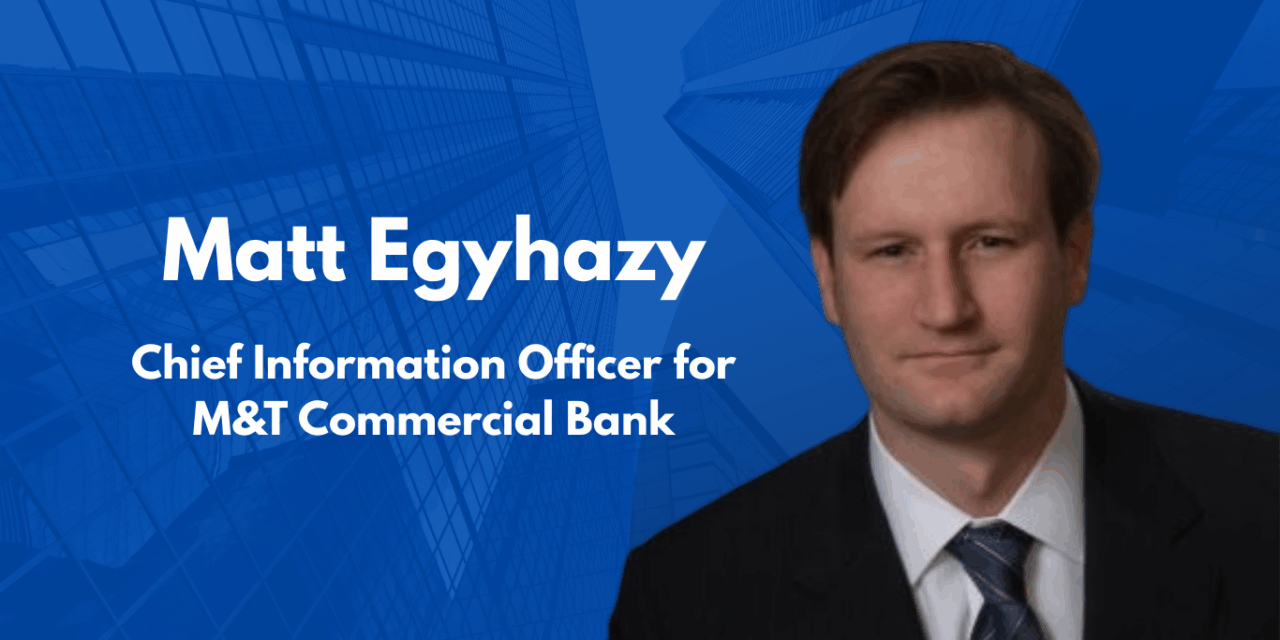
Matt Egyhazy serves as the Chief Information Officer for M&T Commercial Bank and Wilmington Trust. In this executive capacity, he is directly responsible for leading the technology organizations that support the Commercial Bank, Credit Administration, Corporate Treasury, Enterprise Payments, and Wilmington Trust. His leadership ensures the strategic alignment of technology with the complex needs of these critical business lines, driving innovation and operational excellence across the enterprise.
Before joining M&T Bank, Matt held several key leadership positions at Genworth Financial, where he was the Chief Data Officer, Head of IT Strategy, and Chief Architect. His extensive career also includes senior technology leadership roles at other prominent financial institutions, including Capital One, JPMorgan Chase, and SWIFT. This background has provided him with deep and varied expertise across a wide spectrum of financial services, from Commercial Banking and Capital Markets to Wealth Management, Payments, and Insurance.
Matt’s technical and business acumen is reinforced by a strong academic foundation. He earned a Bachelor’s degree in Computer Science from the University of Virginia, a Master’s degree in Computer Science from Virginia Tech, and an MBA from Georgetown University. A respected thought leader, Matt is a published author in IEEE journals and business textbooks and contributes to open source technologies, most notably the widely used C++ library, Boost. He frequently engages with academia, participating in events at the University of Rochester to mentor the next generation of technology and data science professionals.
Your recent discourse suggests AI is key to hyper-personalization in banking, not just automation. How does a large, established financial institution begin to transition its mindset and systems to prioritize this hyper-personalized approach?
The transition begins with a shift from siloed data management to a unified data capital strategy. We must treat client data as a single, invaluable asset; this means investing heavily in clean, real time data pipelines and modernizing core platforms, which is a major undertaking for any large firm. It is also about empowering our teams; AI should augment human intelligence, giving relationship managers deep, predictive insights so they can deliver bespoke advice. This move from generic service to customized partnership is what truly drives loyalty.
You have championed the idea of data as “capital.” How does a technology leader convince a board or CEO to assign a tangible value and strict management protocol to data, similar to financial or human capital?
It starts by quantifying the cost of poor data quality: missed revenue opportunities, inaccurate risk modeling, and regulatory fines. Data becomes capital when you link governance directly to profit and loss. For example, demonstrating that clean, integrated customer data reduces client acquisition costs or improves fraud detection efficiency immediately establishes its financial value. We then implement formal data stewardship programs, ensuring accountability for data quality across business lines, mirroring how we manage P&L responsibilities.
Having held senior technology roles across diverse institutions, including JPMorgan Chase, Capital One, and Genworth Financial, what is the single most valuable lesson you learned about leadership in a high stakes, regulated environment?
The most valuable lesson is that flawless execution is a team sport built on psychological safety. In high stakes environments, people must feel secure enough to raise red flags and voice concerns without fear of reprisal, especially when systems are complex. True leadership involves creating an environment of candid feedback, celebrating transparent failure as a learning opportunity, and ensuring every member of the technology and business team understands their critical role in maintaining system integrity and client trust.
Between running, lifting weights, and competitive soccer coaching, you clearly prioritize fitness. How do you find the time to balance the demands of a Chief Information Officer role with such an active personal life?
Finding balance is less about finding time and more about protecting energy. My fitness routine is a non-negotiable mental reset; it is where I manage stress and gain clarity, making me more effective during work hours. Furthermore, coaching competitive soccer with one of my daughters is a vital grounding activity. It reinforces the leadership skills of mentoring and focus, reminding me that the long term development of talent, whether on the field or in the office, requires patience and consistent effort.
In a world of constant cyber threats, what is the most critical area of technological investment for financial institutions right now, and why is it often overlooked?
The most critical area is shifting cybersecurity investment toward identity and access management, particularly moving to zero trust architectures. It is often overlooked because it is an infrastructural, non-customer facing expense, making it harder to champion than shiny new applications. However, sophisticated attacks rarely breach firewalls; they compromise credentials. Therefore, tightly controlling who has access to what, validating every user, and automating privilege escalation is the most powerful defense against both external threats and internal misuse.
You are an author and contributor to open source projects like Boost C++. What role does sharing knowledge, whether through publishing or coding, play in your personal mission or legacy?
Sharing knowledge is essential to legacy; it is about paying forward the immense value I received from others early in my career. Contributing to open source, specifically, is a way to ensure the foundational tools that power innovation remain robust and community driven. Writing for academic and business textbooks allows me to distill decades of experience into actionable insights for the next generation of technologists, encouraging collaborative growth across the industry.
The financial industry competes heavily for technical talent. What strategies do you employ to attract and retain elite technologists who might otherwise gravitate toward pure-play tech companies?
We focus on demonstrating that finance offers deeply meaningful, complex problems that impact millions of people and the stability of the economy. I emphasize that building a globally scalable payments platform or a state of the art risk model presents far greater intellectual challenge than typical consumer app development. Retention relies on creating a culture of mastery and autonomy; we empower our teams, give them access to modern tools, and ensure they are solving critical business problems, not just maintaining legacy systems.
As a technology leader, how do you manage to stay current with the exponential pace of technological change, while simultaneously managing large scale operations?
Staying current requires disciplined information curation and leveraging my expert teams. I delegate operational management to trusted leaders, freeing up mental space to focus on foresight. I dedicate specific time each week to external research, engaging with venture capitalists, academic researchers, and startups. This strategic scanning allows me to identify disruptive trends early, separating momentary hype from true long term technological shifts that demand a strategic response.
You are a fan of Italian soccer club AC Milan and the Washington Commanders. What do you draw from the world of competitive sports that applies to leading a large technology organization?
Competitive sports teach resilience and the critical importance of effective in game adjustments. In technology leadership, you often prepare meticulously, but market or technical forces inevitably force a pivot. Watching teams like AC Milan navigate pressure and execute rapid strategy changes under duress reinforces the necessity of building agile, cross functional teams that can adapt instantly. It is a constant reminder that success comes from focusing on the current play, not dwelling on the last mistake.
Given the rise of FinTech partnerships, how should established financial institutions best structure these relationships to maximize innovation while mitigating operational and regulatory risk?
Partnerships must be structured as mutually beneficial, not just vendor client agreements. We treat FinTechs as co-creators, fostering deep integration while maintaining strict control over core data and client security. The key is using regulatory sandboxes or controlled environments to vet their technology thoroughly before scaling; this mitigates operational risk. Furthermore, leveraging their nimbleness for front end innovation, while utilizing our regulatory expertise and massive client base for distribution, creates a powerful, synergistic model.
About The Author