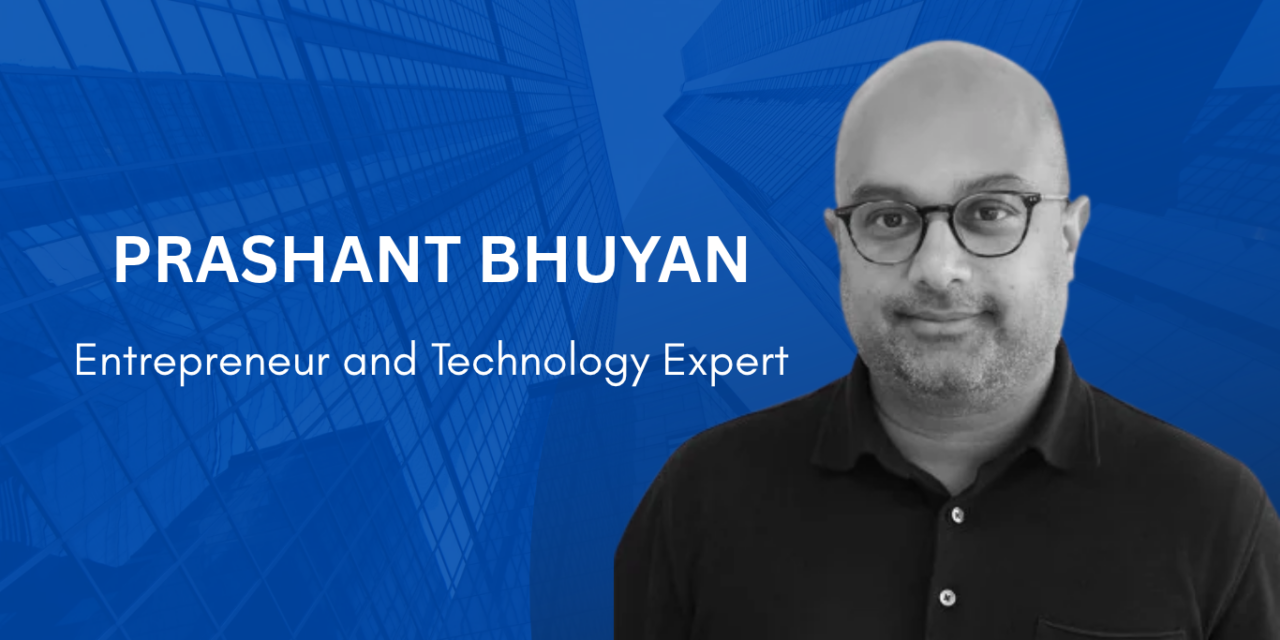
Prashant Bhuyan is an entrepreneur, technology innovator, and thought leader whose career has been shaped by a longstanding interest in the intersection of human intelligence, technology, and complex problem-solving. With a background spanning entrepreneurship, financial technology, data science, and computational thinking, Bhuyan has spent much of his professional life exploring how new ideas and emerging technologies can transform the way people understand information, make decisions, and approach challenges.
A graduate of Hamilton College, where he earned a bachelor’s degree in World Politics, Bhuyan has also pursued advanced studies in mathematics, computation, and data science through Harvard University Extension and the City University of New York. His interdisciplinary educational background reflects an interest in connecting seemingly unrelated fields and applying different ways of thinking to complicated problems.
Throughout his entrepreneurial career, Bhuyan has been drawn to opportunities that challenge conventional approaches. His professional experience includes developing technology-driven ventures, exploring the applications of artificial intelligence, and bringing together individuals with diverse expertise to solve problems that require both technical knowledge and creative thinking. He has long advocated for the value of collective intelligence, recognizing that meaningful innovation often emerges when different perspectives and areas of expertise are brought together.
Bhuyan’s approach to leadership is grounded in curiosity, independent thinking, and continuous learning. He believes that the ability to ask meaningful questions, challenge assumptions, and adapt to new information is increasingly important in a world defined by rapid technological and economic change. His perspective on innovation emphasizes that technology alone is rarely the differentiator; imagination, judgment, and the ability to recognize opportunities are equally important.
In recognition of his entrepreneurial achievements, Bhuyan was named among Goldman Sachs’ Most Exceptional Entrepreneurs at its 2023 Builders and Innovators Summit. He has also been recognized through IBM’s Champion and Cloud Champion programs for his contributions to technology and innovation.
Today, Bhuyan continues to explore the broader implications of technological advancement, organizational intelligence, and the evolving relationship between people and machines. Through his perspectives on entrepreneurship, leadership, and innovation, he encourages individuals and organizations to remain intellectually curious, embrace new possibilities, and recognize that the most meaningful progress often begins with asking better questions.
Seven Questions with Prashant Bhuyan
Your career has spanned entrepreneurship, technology, data science, and innovation. What initially drew you to these fields, and what has kept you interested in exploring new opportunities?
I have always been interested in understanding how things work and, more importantly, why they work the way they do. I tend to approach problems by questioning the assumptions behind them rather than immediately accepting the conventional explanation. That curiosity naturally led me toward technology, mathematics, and entrepreneurship because they all offer opportunities to explore complex problems from different angles.
What has kept me interested is that there is always something new to learn. Technology changes, markets evolve, and the challenges people face become more sophisticated. I have never been particularly motivated by doing something simply because it has been done before. I am more interested in identifying an opportunity that others may not recognize yet and figuring out whether there is a better way to approach it.
I also think entrepreneurship provides a unique environment for intellectual exploration. You are constantly learning, making decisions with incomplete information, and bringing different disciplines together. That combination continues to motivate me.
You have previously emphasized the importance of curiosity and independent thinking. Why do you believe these qualities are so important for professional and personal development?
Curiosity is what keeps people moving forward intellectually. If you stop asking questions, you eventually stop learning. I think one of the biggest mistakes people make professionally is becoming too comfortable with what they already know. Experience is valuable, but it can also create blind spots if you begin assuming that yesterday’s solutions will work for tomorrow’s problems.
Independent thinking is equally important. There is a tendency to follow established practices, industry trends, or the opinions of people who are considered authorities. Sometimes that is appropriate, but meaningful progress often requires someone to question the accepted way of doing things.
I was fortunate to have educational experiences that encouraged me to challenge assumptions and think critically. One lesson that has stayed with me is that learning how to learn is more important than simply accumulating knowledge. The world changes too quickly for any one body of knowledge to remain sufficient forever.
I encourage people to stay curious, explore subjects outside their immediate areas of expertise, and become comfortable asking questions that do not necessarily have obvious answers.
Entrepreneurship involves uncertainty, setbacks, and decisions that do not always produce the expected results. How have you learned to approach failure, and what advice would you offer to other entrepreneurs?
Failure is an unavoidable part of building something new. I have experienced my share of significant setbacks, and I think those experiences have been some of the most valuable in shaping how I approach business and decision-making.
One thing I have learned is that you cannot allow a particular outcome to define your ability or your willingness to keep moving forward. You have to separate the result from the learning opportunity. If something does not work, the important question is why. Was the original assumption incorrect? Was the timing wrong? Did the approach need to change? Or was the problem more difficult than initially understood?
I also believe entrepreneurs need to develop a certain level of comfort with uncertainty. You rarely have all the information you would ideally want before making an important decision. Waiting until everything is predictable can mean missing the opportunity altogether.
My advice is to remain intellectually honest about what is working and what is not. Do not become so attached to an idea that you are unwilling to change it. At the same time, do not confuse an early setback with proof that the broader vision is wrong. Persistence matters, but so does the ability to adapt.
You have spoken about the value of collective intelligence and bringing together people with different areas of expertise. What makes diverse perspectives so valuable when solving complex problems?
I think many of the most interesting problems are too complicated for any one individual to solve independently. They require different types of knowledge, different ways of thinking, and people who are willing to approach the same challenge from different perspectives.
One of the things I have found particularly interesting throughout my career is how much can be accomplished when you bring together talented individuals who may never have otherwise worked together. Someone with a background in mathematics may see a problem differently than someone with experience in finance, engineering, or human behavior. Those differences can become extremely valuable when the objective is to develop a solution that would not emerge from a single perspective.
I have also learned that collaboration does not necessarily depend on everyone sharing the same background or working in the same environment. What matters is establishing a common objective, creating an environment where people can contribute meaningfully, and allowing expertise to be applied where it is most useful.
The strongest teams are not necessarily those where everyone thinks alike. They are the ones where people can challenge one another constructively, exchange ideas, and build on each other’s strengths.
Artificial intelligence and automation are changing the way people work. How do you think individuals and organizations should approach these changes without losing the importance of human judgment and creativity?
I think it is important to move beyond the idea that technological advancement is simply about replacing existing human activities. The more interesting question is how technology can expand what people are capable of accomplishing.
Artificial intelligence can process enormous amounts of information, identify patterns, and perform certain tasks at a scale that would be difficult for individuals to achieve independently. But information processing and sound judgment are not necessarily the same thing. Understanding context, recognizing when something does not make sense, and knowing which questions to ask remain extremely important.
I believe the most effective approach is to understand where technology can improve efficiency and where human experience and judgment should remain central. Organizations should not adopt new technologies simply because they are available or because everyone else is doing so. They should begin with the problem they are trying to solve and determine whether the technology genuinely improves the outcome.
For individuals, I think adaptability will become increasingly important. Rather than viewing technology as something to compete against, people should learn how to work alongside it while continuing to develop the uniquely human capabilities that make them valuable. Creativity, imagination, critical thinking, and the ability to connect ideas across different disciplines will remain important differentiators.
What do you believe separates effective leaders from those who simply hold positions of authority, particularly in industries experiencing rapid change?
I think effective leadership begins with the ability to establish a clear direction while remaining open to the possibility that your original assumptions may need to change. Holding a position of authority does not automatically make someone an effective leader. Leadership requires judgment, accountability, and the willingness to make difficult decisions.
One quality I value is intellectual humility. Leaders need to recognize that they do not have all the answers and that some of the best ideas may come from people who have less experience or hold different positions within an organization. If a leader creates an environment where people are afraid to challenge assumptions, the organization loses an important source of insight.
I also believe effective leaders need to understand the difference between activity and progress. It is easy for organizations to become consumed by meetings, processes, and short-term objectives without stepping back to consider whether those activities are actually moving them toward something meaningful.
In rapidly changing industries, leadership requires balancing conviction with adaptability. You need to have enough confidence to pursue a direction, but enough perspective to recognize when circumstances have changed. The ability to make that distinction is one of the most important qualities a leader can develop.
Looking ahead, what do you believe will be the most important qualities for individuals and organizations seeking to remain relevant over the next decade?
I believe curiosity, adaptability, creativity, and independent thinking will become increasingly important. We are entering a period in which the pace of technological advancement is changing the nature of work, business, and the way people interact with information. The individuals and organizations that succeed will be those that can continuously learn and evolve.
I would also emphasize the importance of imagination. When a new technology becomes widely available, its existence alone does not create a meaningful advantage. The real opportunity comes from understanding what can be done with it that was not previously possible. That requires people who can think beyond established applications and envision entirely different approaches.
Organizations will also need to become more comfortable with interdisciplinary thinking. Some of the most significant opportunities will emerge at the intersection of fields that have traditionally operated independently. The ability to connect ideas, share expertise, and recognize patterns across different areas of knowledge can create tremendous value.
Ultimately, I think remaining relevant is less about predicting exactly what the future will look like and more about developing the ability to respond intelligently when it arrives. You cannot control the pace of change, but you can control your willingness to learn, question, experiment, and adapt. That mindset has guided much of my own journey, and I believe it will become even more valuable in the years ahead.
About The Author