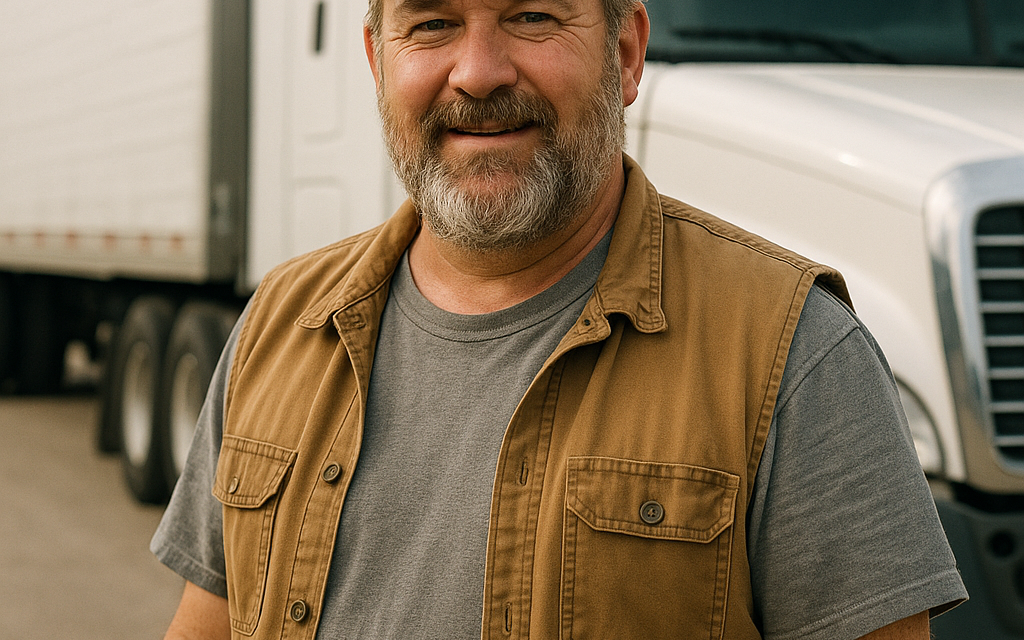
Scott Borgerson was born in Essex, Maryland, a working-class town along the Chesapeake Bay. He grew up in a family where showing up and doing your job mattered. His father worked at the Bethlehem Steel plant until it closed. His mother was a nurse at a local hospital. From them, Scott learned the value of responsibility and steady effort.
As a teenager at Kenwood High School, Scott gravitated toward shop class and auto mechanics. He liked working with his hands and solving problems. College was never the plan. Instead, he earned his Commercial Driver’s License at 21 and took to the road. Truck driving gave him independence, purpose, and a clear sense of direction.
Over more than two decades, Scott has logged over two million accident-free miles along the East Coast. He has hauled everything from food to construction materials, keeping schedules tight and standards high. Today, he works for a Baltimore-based shipping company and is known for his calm presence, safety record, and reliability. Younger drivers often seek him out for advice, and he regularly helps train new hires on safe driving and time management.
Scott’s impact extends beyond the road. He volunteers at food drives, donates his time and truck to community causes, and hauls wreaths each year for veterans’ graves through Wreaths Across America. At home, he mentors local students interested in the trades and logistics.
Scott lives in Essex with his wife and two children. He fishes the Bay, restores classic trucks, and cheers on the Ravens. For Scott, trucking is more than a job. It’s a way to serve, connect, and lead by example.
What first shaped your sense of direction growing up in Essex, Maryland?
Essex is the kind of place where people notice whether you show up or not. My dad worked at Bethlehem Steel until it shut down, and my mum was a nurse. Neither job was glamorous, but both mattered. Watching them taught me that consistency is its own kind of achievement. You do the work, even when it’s hard, because other people depend on you.
You chose a vocational path rather than a traditional college route. How did that decision come together?
I always liked working with my hands. In high school, shop class and auto mechanics made sense to me in a way textbooks never did. I spent weekends with my uncle working on engines. When I earned my CDL at 21, it felt like a natural next step. Truck driving combined problem-solving, independence, and responsibility. It wasn’t a fallback. It was a deliberate choice.
What did the early years on the road teach you?
Patience, mostly. I started driving refrigerated trucks for a grocery distributor, which meant tight schedules and zero room for mistakes. If you’re late, shelves go empty. That stays with you. It taught me that small decisions add up. Leaving five minutes early. Checking a load twice. Those habits turn into confidence over time.
You’ve logged more than two million accident-free miles. How do you maintain that standard?
By never assuming yesterday’s success guarantees today’s. Safety isn’t a personality trait. It’s a routine. I slow down when others speed up. I stop when I’m tired. That mindset applies beyond driving. Risk isn’t about being fearless. It’s about knowing which risks are worth taking and which ones aren’t.
How do you think your work influences younger drivers?
I don’t try to motivate anyone. I just explain why I do things the way I do. When new drivers ask questions, it’s usually about time management or handling pressure. I tell them trucking isn’t about rushing. It’s about control. Once they see that, their confidence changes. They stop reacting and start planning.
What role does mentorship play in your own sense of purpose?
A big one. I didn’t have a formal mentor, but I learned by watching drivers who took pride in their work. Now I try to be that example. I lead safety sessions at work and talk to students at local high schools about careers in the trades. Not everyone needs a four-year degree to build a stable, meaningful life.
You’re active in community work. Why does that matter to you?
Driving connects you to everything. Food. Medical supplies. Construction. When you realise that, it changes how you see your job. Volunteering at food drives or hauling wreaths for veterans reminds me that service doesn’t have to be complicated. You use what you have. In my case, that’s a truck and time.
How do you inspire confidence in your own decisions after so many years on the road?
By staying curious. I still attend safety workshops through the Maryland Motor Truck Association. I still ask questions. Confidence comes from staying sharp, not from thinking you’ve mastered something.
Looking back, what’s helped you get where you are today?
Respect for the work. Respect for people. And understanding that success doesn’t have to be loud. Sometimes it looks like showing up every day, doing your job well, and helping others find their footing along the way.
About The Author