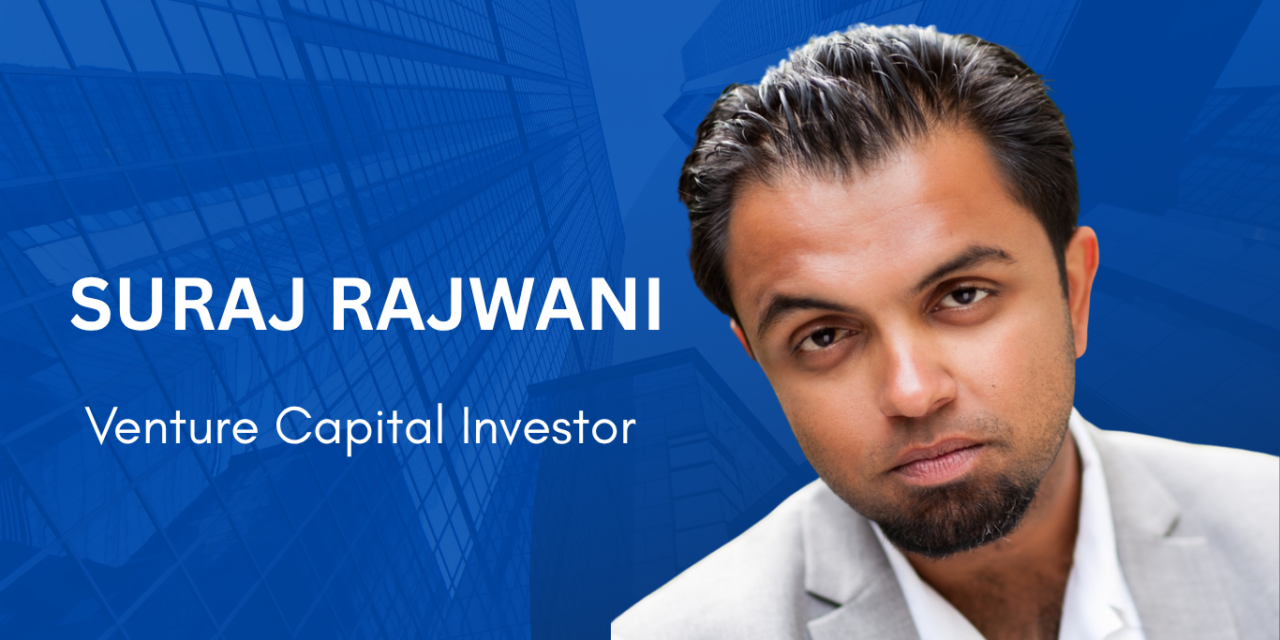
Suraj Rajwani is a Silicon Valley venture capital investor and business strategist with deep experience supporting founders in high-growth technology sectors. As Managing Partner of DoubleRock, a venture capital firm headquartered in Palo Alto, California, he leads investments in artificial intelligence, cybersecurity, healthcare, biotech, and IoT. Since founding the firm in 2012, Rajwani has focused on identifying entrepreneurs with strong leadership potential and scalable business models capable of creating long-term market impact.
Over the course of his career, Rajwani has invested in more than 15 companies and helped guide several portfolio businesses through successful acquisitions and exits. He currently manages a fund valued at approximately $150 million and works directly with founders through active board involvement and hands-on support across growth strategy, fundraising preparation, executive recruiting, operational planning, market expansion, and M&A strategy. Rajwani regularly advises portfolio companies through critical scaling phases, acquisition opportunities, and long-term strategic decision-making. His investment approach prioritizes disciplined execution, adaptability, and sustainable growth rather than short-term momentum.
At DoubleRock, Rajwani also oversees the firm’s incubation program, where early-stage startups receive hands-on guidance during critical phases of development. He believes venture capital should provide more than funding alone, which is why he remains actively involved with portfolio companies as they navigate scaling challenges and competitive markets. His portfolio includes companies such as Optimal, where DoubleRock achieved an 86.3% internal rate of return following the company’s acquisition by Brand Networks, and Vurb, which later sold to Snapchat.
Before establishing DoubleRock, Rajwani served as Managing Director of the Global Entrepreneurs Network Organization in Singapore. During his tenure, he expanded the organization into 23 countries and 37 franchises while helping facilitate approximately 15 investor transactions annually across global markets. He later founded DomainsCable, a digital asset brokerage business that has generated more than $800,000 in revenue through transactions involving companies such as Microsoft, Salesforce, Yahoo, and SoftBank.
In addition to his investment work, Rajwani frequently speaks on venture capital, startup growth, AI innovation, and the future of healthcare technology. He continues to support entrepreneurs building businesses designed for lasting growth and meaningful industry impact.
What do you think has changed most in Silicon Valley investing over the last decade?
Over the last decade, I think the biggest shift has been the move from growth at all costs to disciplined execution. When I started DoubleRock, there was a lot of emphasis on momentum, user growth, and rapid expansion without always having a clear path to sustainability. Today, investors are far more grounded. They want to see real revenue logic, operational control, and founders who understand how to build durable companies. I also see a big shift in how early investors engage with startups. It is no longer just about capital. It is about being involved in hiring, product direction, and strategic decision making. At DoubleRock, I have always believed in staying close to founders, but now that approach has become standard across the industry. The market has matured, and the expectations have become much more demanding in a positive way for long term outcomes.
How do you evaluate whether a founder is truly investable beyond the idea itself?
I always say ideas are easy to find, but execution is what separates outcomes. When I evaluate a founder, I focus heavily on how they think under pressure and how clearly they understand the problem they are solving. If a founder cannot explain why their solution matters in simple terms, that is usually a concern. I also look at their ability to adapt when things do not go as planned, because every startup faces unexpected challenges. Another important factor is whether they can attract and retain strong talent early on, since that often reflects leadership strength. Over time, I have learned that the best founders are not always the most experienced, but they are the ones who stay consistent, make decisions quickly, and remain focused on building something meaningful even when the environment changes around them.
What role does artificial intelligence play in your current investment strategy?
Artificial intelligence is central to what we are evaluating today, but not in the way many people assume. I am less interested in surface level applications and more focused on how AI is being integrated into real business infrastructure. The companies that stand out are those using AI to improve decision making, automate complex workflows, or enhance productivity in measurable ways. At DoubleRock, we spend a lot of time understanding whether an AI product can scale within enterprise environments and whether it actually reduces cost or increases efficiency. Another important factor is data responsibility. As AI becomes more embedded in business systems, governance and transparency matter more than ever. I believe the strongest opportunities in AI will come from companies that quietly power industries rather than those that rely on hype or consumer attention alone.
Why do so many startups struggle with scaling even after raising capital?
A lot of startups underestimate how different building a company is from getting early traction. Raising capital can create momentum, but it does not solve structural issues like poor hiring decisions, unclear product positioning, or weak operational systems. I have seen companies with strong funding struggle because they expand too quickly without building a foundation that supports growth. Scaling requires discipline, patience, and constant alignment between product, market, and execution. Another common issue is lack of focus. Founders sometimes try to do too many things at once instead of refining what already works. At DoubleRock, we spend a lot of time helping founders slow down in the right areas so they can speed up where it matters. Sustainable scaling is not about speed alone, it is about control and clarity at every stage of growth.
How important is operational discipline when evaluating early stage companies?
Operational discipline is one of the most important indicators of long term success. Even at the earliest stages, you can usually tell whether a founder understands how to manage resources, prioritize work, and make decisions based on data rather than emotion. Startups that lack structure often struggle when they begin to scale because inefficiencies become magnified over time. I look for founders who are thoughtful about hiring, careful with capital allocation, and clear about their priorities. It is not about being overly rigid, but about having enough structure to support growth without creating unnecessary complexity. The best early stage companies I have worked with are the ones that stay lean but focused. They know what to ignore, what to prioritize, and how to adjust quickly when the market gives them feedback.
What trends are you seeing in cybersecurity investments right now?
Cybersecurity has become a core part of every technology conversation, especially as companies rely more on digital systems and AI driven tools. What stands out today is the shift toward proactive security rather than reactive solutions. Investors are increasingly interested in companies that can predict threats before they happen rather than simply responding after an incident. There is also growing demand for platforms that integrate security into the infrastructure itself instead of treating it as an add on. At DoubleRock, we see strong interest in identity protection, automated threat detection, and systems that can operate at enterprise scale. The reality is that security is now tied directly to business continuity. If a company cannot protect its data and systems effectively, it cannot scale with confidence, no matter how strong the underlying product may be.
How do you think healthcare technology is evolving through venture capital support?
Healthcare technology is going through a meaningful transformation because of data and computational advancements. We are seeing much faster cycles of innovation, especially in areas like diagnostics, drug discovery, and patient monitoring systems. Venture capital is playing a role in accelerating these timelines by supporting companies that combine scientific expertise with strong engineering capabilities. However, healthcare is still one of the most complex sectors to operate in. Regulatory requirements, long development cycles, and clinical validation all require patience. The companies that tend to succeed are the ones that understand this from the beginning and build accordingly. At DoubleRock, we focus on founders who are not only scientifically strong but also operationally disciplined. The most promising opportunities often sit at the intersection of healthcare and AI, where data can meaningfully improve outcomes and efficiency across the system.
What is your approach to helping startups beyond providing funding?
I have always believed that capital alone is not enough to build a successful company. At DoubleRock, we stay actively involved with founders through different stages of growth. This includes helping with hiring decisions, refining product strategy, preparing for fundraising, and supporting operational planning. In many cases, early stage founders benefit from having someone who can help them see the bigger picture while still staying focused on day to day execution. Our incubation program is designed for that purpose. We work closely with startups to help them strengthen their business models and build scalable foundations. I also spend a lot of time speaking directly with founders because those conversations often reveal challenges that are not visible in metrics alone. The goal is always to help companies build in a way that supports long term success rather than short term acceleration.
What patterns do you see in companies that achieve successful exits?
Companies that achieve successful exits usually share a few consistent traits. First, they maintain a clear focus on solving a specific problem rather than expanding too broadly too early. Second, they build strong leadership teams that can operate independently and make decisions quickly. Third, they stay disciplined with execution even when external conditions change. In many of the exits I have been part of, including companies like Optimal and Vurb, the key factor was not just innovation but consistent operational performance over time. Buyers and acquirers look closely at how predictable a business is and how well it can integrate into larger systems. If a company has strong fundamentals, clean operations, and a clear value proposition, it becomes significantly more attractive during acquisition discussions. Execution always ends up being the deciding factor.
What advice would you give founders entering the market in 2026?
My advice to founders in 2026 is to focus on clarity and discipline from day one. The market is competitive, and investors are paying close attention to how well founders understand their own business. It is important to validate the problem early, build a focused product, and avoid unnecessary complexity. I also encourage founders to think about scalability from the beginning rather than treating it as a later stage concern. Another key point is patience. Building a strong company takes time, and shortcuts usually create problems later. At the same time, founders should stay flexible and willing to adjust when they receive market feedback. The most successful entrepreneurs are the ones who balance ambition with execution. They stay grounded in reality while continuing to push forward with a clear and consistent vision.
How do you define long term success as a venture capitalist?
Long term success in venture capital is not just about returns, although that is part of it. For me, it is about backing companies that create real value and continue to grow long after the initial investment cycle. It is also about building strong relationships with founders and supporting them through different phases of their journey. At DoubleRock, we focus heavily on alignment between investors and entrepreneurs because that alignment is what sustains companies during difficult periods. Over time, I have learned that the most meaningful outcomes come from consistency rather than short term wins. If you consistently support strong founders, help them navigate challenges, and stay focused on fundamentals, the results tend to follow naturally. Long term success is really about discipline, patience, and making decisions that prioritize durability over speed.
About The Author