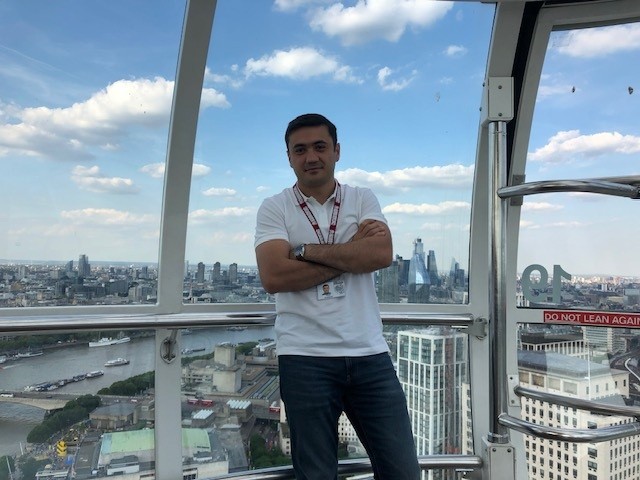
Ramil Asadulzada has spent more than two decades building a career defined by discipline, global perspective, and steady leadership. With over 20 years of experience across finance and operations — including more than 11 years with SOCAR — he has held senior roles such as CFO and most recently CEO of SOCAR Petroleum SA.
Born and raised in Azerbaijan, Ramil built his foundation through education and focus. He earned an MBA with Honors from the University of Chicago Booth School of Business and became a member of ACCA. His career has taken him across Azerbaijan, Turkey, Switzerland, and Romania. Each move expanded his understanding of markets, risk, and strategy.
Colleagues describe him as calm under pressure. He values preparation. He studies numbers carefully. But he also listens.
“Leadership is responsibility,” he has shared in past interviews. “You earn trust by being consistent.”
During his time as CFO and CEO, Ramil focused on financial discipline, long-term planning, and building strong teams. He believes growth must be sustainable. He believes decisions should balance ambition with risk awareness.
Outside of work, he remains committed to learning. He reads. He travels. He gives back quietly through private philanthropy.
Ramil’s journey reflects a simple principle: steady effort compounds. His career shows how global experience, structured thinking, and thoughtful leadership can shape both organizations and the people within them.
Q&A:
You’ve built a 20-year career across multiple countries and leadership roles. What inspired you early on?
I grew up in Azerbaijan at a time when change was constant. That environment teaches you to value stability and education. I was always drawn to structure. Numbers made sense to me. Finance felt like a language that explained how systems worked. When I began my career, I realized that strong financial thinking could shape entire organizations. That idea stayed with me.
You later earned an MBA with Honors from the University of Chicago Booth. What did that experience change for you?
Booth sharpened how I think about risk. Before that, I understood finance operationally. At Booth, I learned to think in probabilities and long-term scenarios. One professor would challenge us to defend decisions under extreme downside conditions. That stayed with me. It shaped how I approach leadership. You don’t just plan for success. You plan for stress.
You’ve worked in Azerbaijan, Turkey, Switzerland, and Romania. How did that global exposure influence your leadership style?
Every market behaves differently. In Turkey, speed and relationships matter deeply. In Switzerland, precision is everything. In Romania, adaptability becomes key. I learned that leadership is not about imposing one model everywhere. It’s about understanding context. When I became CFO and later CEO at SOCAR Petroleum SA, I leaned on that adaptability. You build trust by respecting local nuance while keeping standards consistent.
How do you inspire confidence in big ideas, especially in industries like oil and gas where risk is high?
Confidence comes from preparation. When presenting a new initiative, I always walk the team through the downside first. I show them what happens if assumptions fail. When people see that risk is accounted for, they relax. One time, we were evaluating a large operational shift. Instead of focusing on growth projections, I started with risk containment scenarios. That changed the tone of the conversation. It made the idea stronger.
You’ve moved from CFO to CEO. How did your leadership evolve?
As CFO, I focused heavily on numbers and controls. As CEO, I had to expand that lens. Leadership became more about people. Listening became critical. I realized that teams perform better when they feel heard. I still value discipline, but I also understand motivation matters. Structure gives direction. Culture sustains momentum.
What inspires you today?
Long-term thinking inspires me. I enjoy seeing how disciplined decisions compound over time. I also find inspiration in young professionals entering the field. When I mentor someone and see them grow into leadership, that is meaningful. It reminds me of my early years.
How do you approach taking risks?
Risk should be calculated, not emotional. I separate strategic risk from impulsive risk. Strategic risk has data behind it. It has buffers. It has contingency plans. Impulsive risk is driven by ego or urgency. I avoid that. In energy markets, volatility is constant. Stability comes from preparation, not prediction.
You’re also involved in private philanthropy. Why is that important to you?
Success carries responsibility. I prefer to contribute quietly. Supporting education and community initiatives feels aligned with my own path. Education changed my life. It makes sense to support that for others.
What advice would you give someone early in their career?
Focus on competence first. Titles come later. Develop technical skill. Understand the fundamentals deeply. Then expand into leadership. And be patient. Steady progress builds credibility.
Looking back, what do you think truly shaped your journey?
Consistency. Moving countries was not always easy. Leading during uncertain periods was not simple. But steady discipline builds resilience. Over time, that resilience creates opportunity.
Ramil Asadulzada’s story reflects structured ambition. Global exposure refined his perspective. Financial discipline anchored his decisions. Listening shaped his leadership. And steady effort carried him from early finance roles to CEO.
About The Author