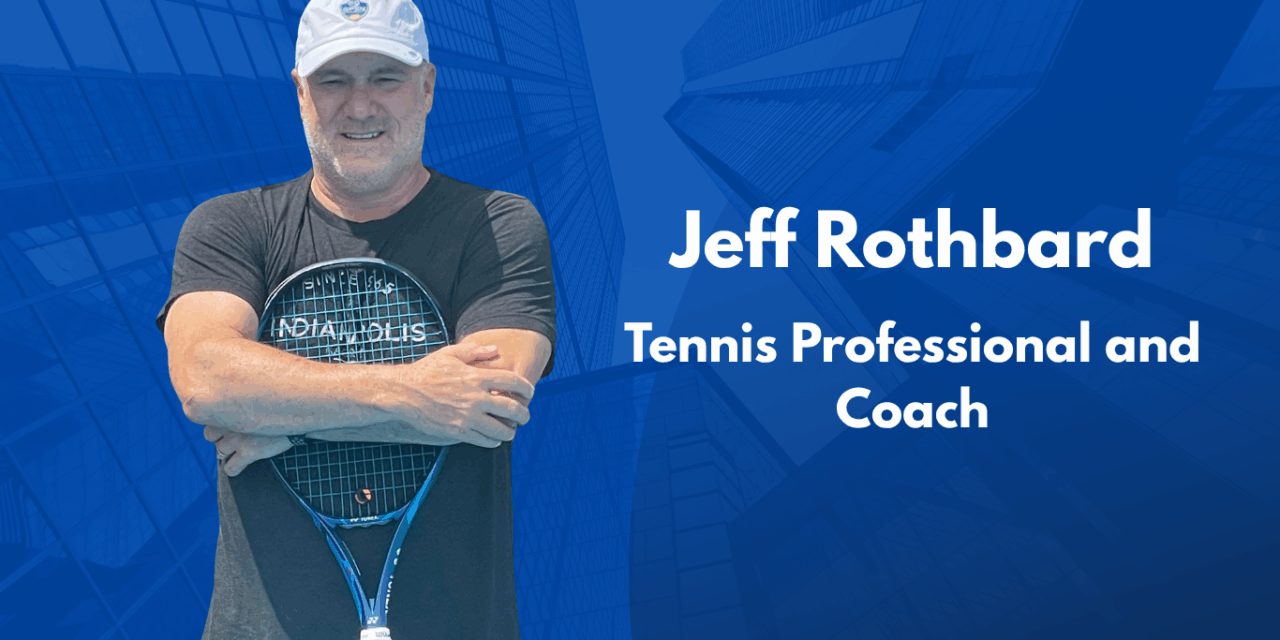
Jeff Rothbard, widely known as “Coach Jeff,” is a dedicated tennis professional whose passion for the sport is matched only by his commitment to helping players grow on and off the court. Splitting his time between Carmel, Indiana, and South Barrington Club in South Barrington, IL, Jeff works with athletes of all ages and skill levels, from eager beginners picking up a racket for the first time to competitive juniors and seasoned adult players chasing their next win.
His philosophy is simple yet powerful: a great attitude combined with great effort leads to great results. Guided by this belief, Jeff’s coaching emphasizes mental resilience, strong fundamentals, and purposeful movement. Players in his sessions learn to focus on the process rather than perfection, using techniques like the “bounce-swing” rhythm to develop timing, positive footwork and the “Next Time” reflection method to turn mistakes into opportunities for growth. Whether he is leading a high-energy group clinic or providing focused one-on-one guidance, Jeff creates an encouraging, structured environment where players can thrive.
Before returning to his lifelong love of tennis, Jeff built a successful 30-year career in business. As the founder and president of SilverCreek Properties, he developed and managed commercial real estate projects across 18 states, expanding the company to 60 properties before selling. This same drive and strategic thinking now shape his coaching.
Today, Jeff’s mission is about far more than teaching tennis. He strives to build not just stronger players but stronger people, confident, disciplined, and adaptable individuals who carry the lessons they learn on the court into every aspect of their lives.
You’ve transitioned from running a multi-state real estate empire to coaching tennis full-time. What was the pivotal moment that made you trade boardrooms for backhands?
Honestly, it came down to joy and fulfillment. I had a great run in business and grew SilverCreek Properties to 60 locations in 18 states with incredible teams across the country, and I was proud of what we achieved. But I realized that my happiest and most energized moments were always on a tennis court rather than in a conference room. I wanted to connect with people in a way that had an immediate and visible impact where I could watch them grow in skill and confidence right in front of me. Tennis was my first love since I was young, and after decades in business I felt a strong pull to return to it with the same drive I had brought to my companies.
You’re known for phrases like Positive Footwork and“Next Time” reflection. How did that concept develop, and have you ever had to apply it in your own life outside of tennis?
“Next Time” came from watching players get stuck on their mistakes and lose their rhythm. I tell them to acknowledge the error, take the lesson from it, and then immediately move forward to the next point. It is not about pretending it never happened, but rather about shifting your focus to what you can control in the moment. Positive Footwork works the same way, it’s about moving with intent, staying balanced, and putting yourself in the best position for the next ball rather than dwelling on the last one. I have applied both of these in my own life countless times, whether in high-pressure business negotiations, in raising my kids, or in navigating personal challenges. Life does not give you rewinds, but it always gives you a next time, and that mindset has saved me from dwelling on setbacks.
Your coaching blends purposeful movement with a growth mindset. What’s one drill or exercise you swear by that players initially resist but later thank you for?
Without a doubt, it is footwork ladders. In the beginning, many players see them as tedious or as just another warm-up. But as soon as they notice how their reaction time sharpens, their balance improves, and their shot preparation becomes second nature, they understand why it matters. I often tell them, “You win points with your feet before you win them with your racket.” Once they feel the difference in a match, they are sold.
You’ve worked with athletes of all levels. How do you adjust your approach when coaching a complete beginner versus a seasoned competitor chasing titles?
With beginners, I focus on making the game approachable and fun while still laying down a solid technical foundation. I want them to fall in love with the sport while learning the right habits from day one. For advanced competitors, it is about finding those small and often overlooked adjustments in movement, shot selection, or mental approach that can be the deciding factor in a tight match. The coaching is more strategic, but the heart of it is the same, which is to build confidence and trust in the process.
In your experience, what’s the biggest mental barrier that holds players back, and how do you help them break through it?
Fear of failure is the biggest one. Many players hold back because they are afraid of looking bad or losing a point in front of others. I help them reframe mistakes as improvement. If you are not willing to take risks and miss shots, you will never unlock your full potential. The courage to fail is the first step toward truly winning.
After decades in high-stakes business, what business skills surprisingly help you most on the tennis court as a coach?
Strategic planning is at the top of the list. In real estate, you have to understand the big picture, prepare for challenges before they happen, and make quick adjustments when conditions change. Coaching tennis is similar. I teach players to read the game, anticipate their opponent’s next move, and adapt their strategy in the middle of a rally. That ability to think ahead is often what separates good players from great ones.
Tennis is a sport of both precision and passion. How do you keep players disciplined without dimming their love for the game?
I show them that discipline is actually what creates freedom on the court. When your fundamentals are solid and your conditioning is strong, you can play with more creativity and confidence because you trust yourself. Instead of restricting players, discipline unlocks their ability to take bold shots and play the game they truly love.
You coach in both Carmel, Indiana, and Charleston, South Carolina, two very different tennis cultures. How does the local environment influence your coaching style?
Carmel players often come with a strong, structured training background, which means they are used to a certain level of intensity and precision. With the players in South Barrington, they bring a more relaxed style and are very eager to learn. I adjust my coaching to bring the best of both worlds together so that no matter where I am, players get a complete approach to the game.
If you could go back and coach your younger self as a tennis player, what one piece of advice would you give?
I would tell myself to stop rushing improvement and to truly trust the process. At 15, I wanted every skill to be perfect immediately, and I often got frustrated when progress was slow. Now I know that mastery is built on patience, persistence, and the willingness to work on the little things day after day.
Looking ahead, what kind of legacy do you want to leave, not just in tennis, but in the lives of the players you have mentored?
I want every player I coach to walk away with more confidence than they had when they first stepped on the court. Tennis is the tool we use, but the real goal is to shape disciplined, resilient, and adaptable people. If my players take those qualities into their careers, their relationships, and their communities, then I will consider that the greatest win of all.
About The Author